

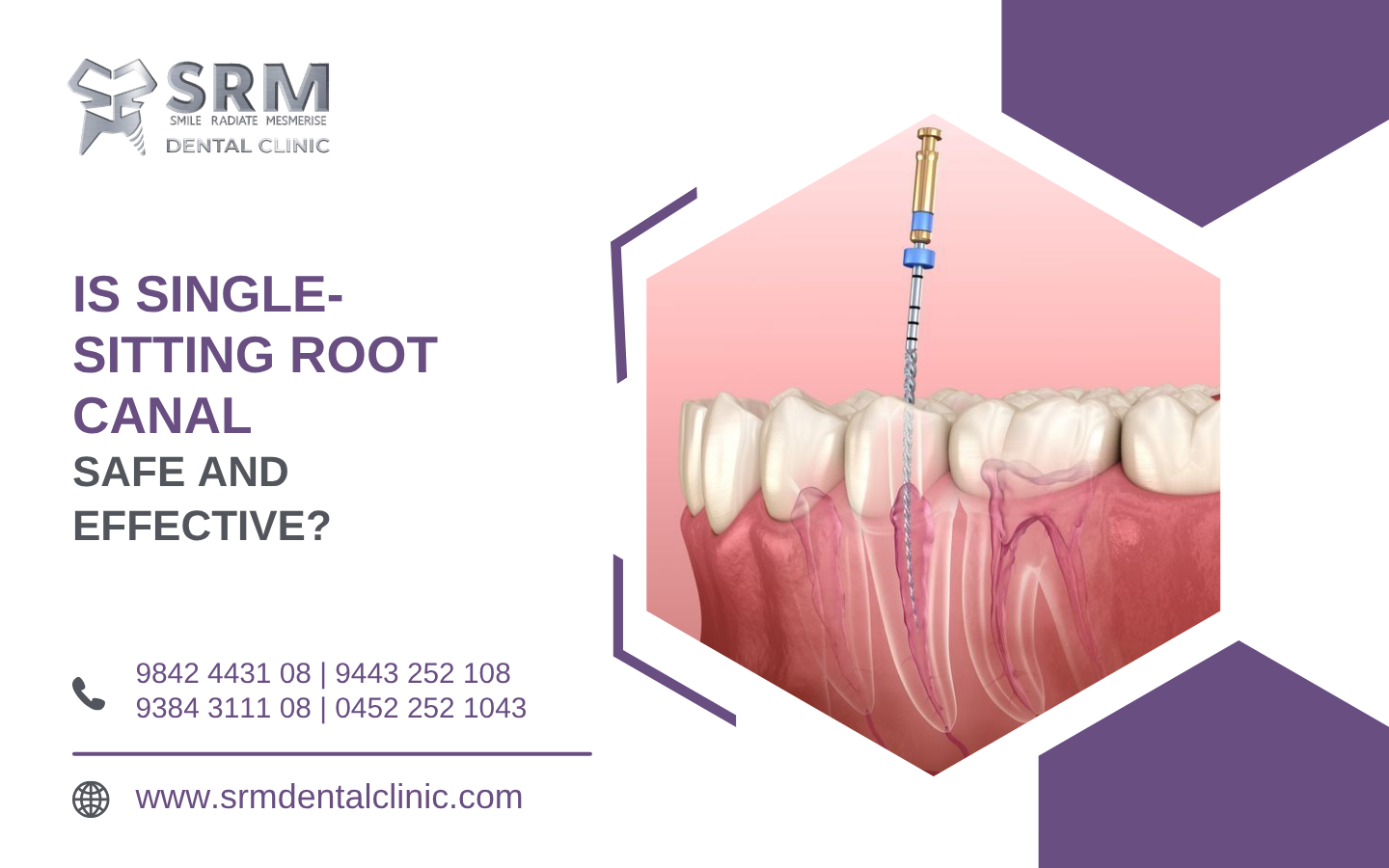
There is a very particular moment most patients remember.
The pain has been building quietly. A little discomfort while chewing. A sudden, sharp response to something cold. Then one day, it turns into constant, distracting, and cannot be ignored pain.
And that is when the question comes up.
“Will this take multiple visits… or can it be done in one?”
At SRM Dental Clinic, many patients ask us about single-sitting root canal treatment in Madurai because the idea sounds convenient. One visit, one procedure, and relief.
But convenience alone is never enough. What really matters is safety, effectiveness, and long-term success.
What Does “Single-Sitting” Really Mean?
A single-visit root canal simply means the entire cleaning, shaping, and sealing of the tooth is completed in one appointment.
Traditionally, root canals were spread across multiple visits. Today, with advanced root canal treatment techniques, we can often complete it in one sitting when conditions allow.
Here is what changes:
- Diagnosis, cleaning, and filling happen together
• No temporary fillings between visits
• Faster relief from severe tooth pain
• Fewer chances of contamination between appointments
This approach is especially useful when the tooth infection is identified early and controlled.
When Is a Single-Sitting Root Canal a Good Option?
Not every case fits into a single-visit root canal plan.
We evaluate carefully before recommending single-sitting root canal treatment in Madurai. The condition of the tooth decides the approach.
Suitable cases usually include:
- Mild to moderate tooth infection
• No excessive swelling in gums
• Straightforward root structure
• Patient with good general health
When these conditions are met, advanced root canal treatment becomes both safe and efficient.
When Multiple Visits Are Still Better
There are situations where spacing out treatment is safer.
We prefer a staged approach when:
- There is severe swelling in gums
• Infection is widespread
• Pus discharge is present
• Complex root anatomy is involved
In such cases, rushing the process can compromise healing. Endodontic treatment must always adapt to the tooth, not the other way around.
The Step-by-Step Process
Many patients feel anxious simply because they don’t know what happens during the procedure.
Here’s how a single sitting treatment usually flows:
- Diagnosis and Imaging
We take X-rays to understand the depth of the tooth infection and root structure. - Numbing the Area
Local anesthesia ensures painless root canal treatment. - Cleaning the Infection
The infected pulp is removed, and the canals are cleaned thoroughly. - Shaping the Canals
The internal space is prepared to receive filling material. - Sealing the Tooth
The canals are filled and sealed to prevent reinfection. - Final Restoration Planning
In most cases, a crown is advised later for strength.
Is Painless Root Canal Treatment Truly Possible?
This is one of the most common concerns.
With modern techniques, most patients report:
- Minimal discomfort during the procedure
• Immediate relief from severe tooth pain
• Mild soreness for a day or two
Painless root canal treatment is no longer just a promise. It is something we consistently achieve when the procedure is done correctly.
How Effective Is It Long Term?
A root canal is meant to save your natural tooth.
When done properly, the success rate is high. Our single-sitting root canal treatment in Madurai can be just as effective as multiple-visit treatment if case selection is correct.
What supports long-term success:
- Complete removal of infection
• Proper sealing of canals
• Timely placement of the crown
• Good oral hygiene
Skipping aftercare can affect even the best treatment.
Why Some Patients Prefer Single Sitting
Convenience plays a role, but it is not the only reason.
Patients often choose it because:
- Fewer clinic visits
• Less time off work
• Faster return to normal eating
• Reduced anxiety from repeated appointments
For busy lifestyles, this approach fits naturally.
A Quick Comparison
| Aspect | Single Sitting | Multiple Sitting |
|---|---|---|
| Number of Visits | One visit | Two or more visits |
| Treatment Duration | Completed in a shorter overall time | Treatment spread across multiple appointments |
| Infection Control | Suitable for controlled or mild infection cases | Preferred for severe or complex infections |
| Patient Comfort | High comfort with modern techniques | Gradual process with shorter sittings |
What About Infection Control?
This is where many doubts arise.
Can everything really be cleaned in one sitting?
The answer depends on the condition of the tooth.
Modern endodontic treatment tools allow us to:
- Clean deeper and more precisely
• Use disinfecting solutions effectively
• Seal canals immediately
Note: In cases of severe infection, spreading bacteria, or abscess, we may avoid a single-sitting treatment. Patient safety always comes first.
Recognizing When You Need Treatment
Delaying care is what turns a simple issue into a complicated one.
Watch for these signs:
- Persistent severe tooth pain
• Tooth sensitivity to hot or cold
• Swelling in gums
• Pain while chewing
• Darkening of the tooth
These are common signs of tooth infection that may require infected tooth treatment.
The Role of Technology in Better Outcomes
Modern dentistry has changed how we approach root canals.
With advanced root canal treatment tools, we now use:
- Rotary instruments for precise cleaning
• Digital imaging for better diagnosis
• Magnification for detailed work
These advancements make single-sitting root canal treatment in Madurai more predictable and safe at SRM dental clinic.
Recovery: What to Expect After the Procedure
Recovery is usually smooth.
After treatment, you may notice:
- Mild tenderness for a day
• Slight tooth sensitivity while chewing
• Gradual relief from pain
To support healing:
- Avoid chewing on that side initially
• Maintain good oral hygiene
• Follow prescribed medication
This ensures the infected tooth treatment heals properly.
Common Myths That Still Exist
There are a few ideas that make patients hesitate.
Let us clear some of them:
- Root canals are painful
• One sitting is rushed
• Extraction is better than saving the tooth
In reality:
- Modern procedures are comfortable
• Proper technique ensures safety
• Saving your natural tooth is always preferred
When Speed Can Be a Risk
Not every fast treatment is better.
We always assess:
- Extent of tooth infection
• Patient’s medical history
• Structural complexity of the tooth
Disclaimer: If infection is severe or spreading, attempting a single-visit root canal procedure may not be ideal. In such cases, staged endodontic treatment ensures better outcomes.
Long-Term Care After Treatment
Once the procedure is done, care continues.
To maintain results:
- Get a crown placed if advised
• Brush and floss regularly
• Avoid biting very hard foods initially
• Visit for periodic check-ups
We recommend to follow this steps to help preserve the results of single-sitting root canal treatment in Madurai.
FAQs
How many root canals can be done in one sitting?
In most cases, one tooth is treated in a single sitting to ensure accuracy and patient comfort. However, if multiple teeth require treatment and the condition allows, they can sometimes be managed in the same appointment. The final decision depends on the severity of infection, tooth structure, and how comfortably the patient can sit through the procedure.
Which tooth is hardest to root canal?
Molars are usually the most difficult teeth to treat because they have multiple roots and complex canal structures. These canals can be narrow, curved, and harder to clean thoroughly. Their position at the back of the mouth also makes access slightly challenging, which is why they require more precision and expertise.
What is the most painful part of a root canal ?
Most patients expect pain during the procedure, but the actual treatment is usually comfortable due to proper anesthesia. The real discomfort often comes from the infection before the treatment begins. Once the infected tissue is removed, the pressure reduces, and relief starts. Mild soreness after the procedure is normal and settles within a few days.
Which teeth cannot be saved with a root canal?
Teeth that are severely damaged, cracked beyond repair, or have very little structure left may not be suitable for a root canal. In such cases, saving the tooth is not possible, and removal may be recommended. The decision is always made after evaluating whether the tooth can function properly following treatment of the infected tooth.
What is ghost pain after a root canal?
Ghost pain refers to a mild sensation or discomfort that some patients feel even after the treatment is completed. This usually happens because the surrounding tissues are still healing and adjusting. It does not necessarily indicate a problem with the treatment. In most cases, the sensation fades gradually as healing progresses.
So, Is It Safe and Effective?
Safety does not come from the number of visits. It comes from correct diagnosis, careful execution, and proper follow-up.
Our single-sitting root canal treatment in Madurai works well when the case is suitable and handled with precision. At SRM Dental Clinic, we focus on choosing the right approach for each patient rather than following a fixed pattern.
A root canal is not just about removing pain. It is about preserving function, comfort, and long-term oral health.
And when done right, one well-planned sitting can be all it takes to turn things around.